Saturday, May 27, 2017

Timing a 200TDI in a 109 Land Rover

Hullo,

    If you are a regular follower you might remember that I had an issue with my fuel injection pump. Ever since I resolved the broken shim and swapped the damaged bits my 109 hasn't been the same.
   It was smoking(nothing new there) and under powered(that's new). When pulling off from a cold start it felt like it was in third gear. Once the engine warmed up it worked better, but I still had underpower issues on hills of any type. I had to have high revs in first or second to get up the street to my house, which I found out the hard way......

   I finally figured out that I needed to re-time the injector pump. Either the parts I swapped were not working right or the timing wasn't correct. Checking the timing would be the least costly thing to do.

   According to the manual to time the 200 you have to put a pin in the drain plug hole for the flywheel when the #1 cylinder is a TDC. The timing mark on the crankshaft pulley now lines up with one of the strengthening webs on the timing cover. Then you pin the injector pump with another pin to keep it from moving. At this point if the injector pin won't go in you have to loosen the pulley on the injector pump and turn it until the pin fits. Tighten it all up and yer done! (IIRC)

My first big problem is that the drain plug hole for the flywheel housing is blocked by the crossmember. No access, zip, zero, can't even see it without a mirror. I fretted and planned for over a month on how I was going to cut my crossmember and bolt up some steel to retain the chassis integrity. I asked on other forums how they did it. Most just lined up the crankshaft timing mark with the web and called it good.

   Which leads to my second problem; I can not get a good visual on the timing mark and the web to see how well it is lined up. The radiator and electric fan are in the way, even using a mirror.......Grrrrrr!
I made a pointer with a magnet and put it on the timing mark, but the web is so wide I couldn't be sure how close I was. I mean it ran but was underpowered.

    I made a pointer to clamp to the web with a fine point but I can't even get my hand in there to clamp it on........Arrrrgh!......

    Not wanting to cut the crossmember I kept thinking.......tick.......tick........tick................clunk.

Knowing I needed to find TDC I decided to pull the #1  fuel injector and stick a bicycle spoke down it and watch to see TDC. Once I put it in I knew it wouldn't be close enough. I needed my dial indicator but I don't have a long enough rod to touch the piston....grrr.....

Then it hit me::THWAK!:: IF my dial calipers would fit down the injector hole I could use the depth finder feature to watch the piston move and find TDC!

It fit!


It took a bunch of tries to figure out exactly how to do it. and getting consistent readings. I found that while I held the fixed and moveable parts of the caliper in the hole I could feel when the piston hit TDC before I visually realized that the gauge had stopped moving.


So I now had TDC dialed in, pun intended ;^)


My next step was to test fit the injector timing pin. And as I thought, it would not fit, the timing was indeed off. According to the book my fix was to move the engine off TDC until the timing pin slipped in, then on the side of the injector pump remove the keeper plate and tighten the bolt and lock the pump. Ya then slacken the 3 bolts on the injector pump gear, turn the engine to TDC. Check the injector pump timing pin fitment(should be easy) and tighten the 3 retaining bolts to the correct torque.
   Back on the side of the injector pump loosen the locking bolt and replace the keeper plate and re-tighten. Remove the timing pin.


I re-installed the injector and lines and fired it up. Just a quick trial in my drive shows it pulls away stronger from a stop. I haven't been able to drive it anywhere yet.

How you ask, did I ever turn the crank and hold on to the calipers and watch them all at the same time? If you remember I use my handcrank that I modified to take a socket which fits the bolt on the crankshaft pulley. Which I turned with my foot.


Saturday, May 6, 2017

Land Rover prop shaft seal repair

OK, OK,... I spent most(all) of my afternoon replacing the seal in the sliding section of my rear propshaft. Why that long I hear you ask, I'll tell you why..

Mine did not have anything but grease under the nut. I have a spare front for an 88 so I took that apart to see what was in there since I can't find anything online that will tell me.

Here's what I found, first that directly under the nut is a split steel washer;


Under that is a split fiber washer;


Alas and alack, I had neither of those on hand and no place to get them. So I improvised I got some cork gasket material some of which is rubberized and figured that I could use 2 sizes to get close to the 5/32" thickness of the original. I measured the OD of the propshaft sliding section for the ID of my seal and the ID of the nut for the OD of my seal. Then using a compass I drew them and cut them out with a safety blade. I made 4, 2 sets so I could have a spare in case I screwed up.


And I wound up with,(one set is stacked up);


I test fit the seals on the shaft;


Good to go!

Then came the hard part! I had to make a split washer. I looked thru my scrap and could not find a suitable piece of steel so I made one from Birmabright. I don't know if it will work but I guess I'll find out. I will also keep my eyes out for some steel to make another one from.

Using my 1-3/16" hole saw I cut out the ID. It is too large as the shaft is 1-5/32" but it was what I have. Then I laid out the steel ring and marked the OD.


Tin snips made a rough cut out and I used my angle grinder in a vise with a flap wheel on it to remove the excess material.


It took FOREVER to get my ring to fit inside the nut, working with a file but I got it. As I was doing this I checked to make sure I was keeping the ID centered when it hit me..........I could use the old ring as a template and file to it's edge.

Pulling some vise grips from the tool box I clamped the 2 bits together and filed away. Second revelation I could do this with the seals too! My first seals got tossed out as the ID and OD's were too large. Now 2 vise grips were employed to hold the materials together while I used the Dremel to quickly make the seals.


At first I cut a triangle to allow the Dremel tool access to the ID, but then I discovered I could just grind right thru the cork. Takes about 3 min to make a seal now.

I split the seals on a 45 sideways and the metal washer on a 90. Put some anti-seize on the threads, lined up the balance marks and tightened the nut. I greased it the other day so unless I find out different it is good to go!


My slip joint travels 2". I learned a lot today, I hope you did too!

Friday, May 5, 2017

Land Rover output shaft seal replaced

My output seal decided to leak. I found it by the drip from my transmission brake when I went to check the transfet case oil level. It wasn't bad and the case was full so I figured I would still drive it.

Well the next day I drove 6 miles and then I could smell oil so I pulled over and it was dripping a lot! So I canceled my bike ride and went home. On the way I had a guy at a one way stop for storm damage walk up and tell me he thought I needed oil due to the smell......I told him thanks and it was a diesel.

It was too hot to do any work so I waited a day more for it to cool down. Then I went to work.

Pulled the rear prop shaft while the oil was draining out of the transfer case. Disconnected the handbrake bell crank from the frame and linkage. Removed the oily brake drum and Yeow!, was it a mess in there with oil! Removed the output shaft w/flange.

I could have stopped there as I now had access to the seal. But I knew it would be easier to replace if I removed the speedo drive housing and worked on it on my bench. So off came the brake backing plate and the speedo housing.

Some brakeclean  sprayed on it cleaned most stuff up and I pounded out the old seal. Cleaned out the mating surface and smeared some gasket maker on the outside of the new seal and pounded it in. Crap! It wouldn't go in a deep as the old seal so I really wailed on it. It bent......That is when I noticed that it was thicker than the old seal.


So I pounded it out and in the above pic you can see them side by side.

Now I have heard on some forums that you can put 2 seals in there to help with the sealing. Not with the genuine ones I have; FRC1780G's


I couldn't find a brand name on the old one, perhaps, SKF  it says CR16245USA on it.


I put a good seal in the speedo housing and using all shims after cleaning them reinstalled it.

Next I cleaned up the brake shoes and backing plate and that was a chore. It is so much easier to reinstall the brake shoes using a vise than it is under the vehicle. All clean they went back on the 109 and then I put in the output flange and the cleaned brake drum.

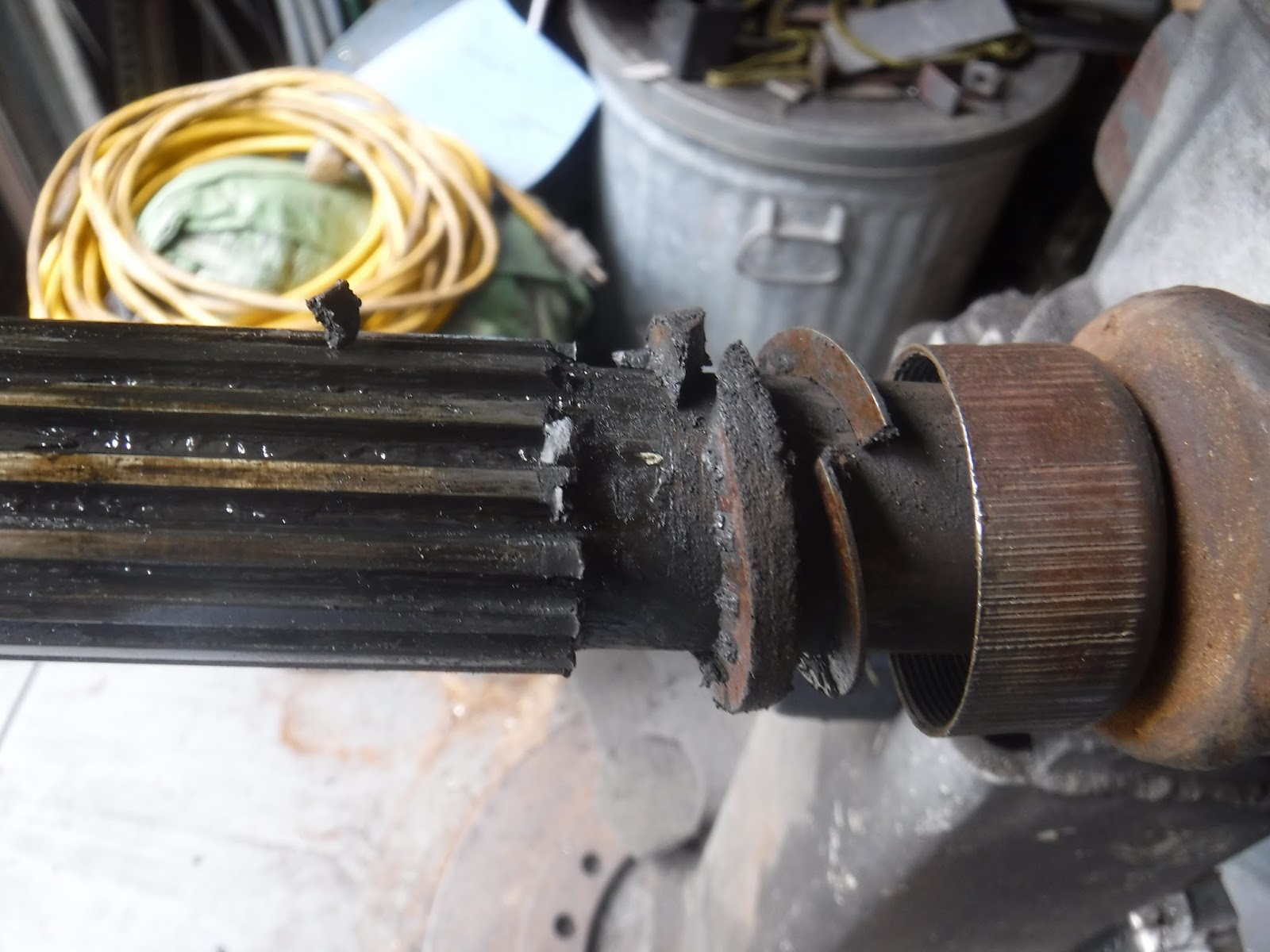
An now it sits. for a couple of reasons. 1) the propshaft boot has fallen apart and I am looking for a new better option, mainly a shock boot. In the process I have discovered that from the factory they didn't come with a boot.. While cleaning up the propshaft I found that the felt seal under the nut on the female section of the propshaft is missing. I have queries out on forums and part suppliers.
     2) I fear that the seal between the mainbox and the transfer case has failed and haven't checked it due to time constraints.
    3) I am tired of working on the 109 and just want it to be reliable. I'm too old for this shit!

Friday, April 28, 2017

Fuel extension tube install

When I put in my second fuel tank under the drivers seat I did not have an extension tube for it. I have been keeping an eye out for one online but hadn't found one. They make pouring a NATO can in SOooo much easier!

Finally I advertised for one on the GnR forum and Colin replied that there was one in a thread on the Series 2 forum for free. So I quickly chased it down and the Poster, 602 agreed to give it to me and post it up from the UK to the States. Of course I offered to pay the postage.

 I received the tube this week and it is in awesome condition! Many thanks 602!!! My hero! The magazine wrapping paper was a bonus!

The hard part was to figure out how to attach the chain to the bottom of the main tube. My hands are too large to fit down in there and I had no tool to clamp the chain that would be long enough. Then I remembered that they made a double scissoring needle nose pliers that is quite long. I stopped in at my local hardware store and found one with the bent nose. PERFECT! (he said)


This tool was able to reach down the tube and clamp the chain, but it wasn't easy. It took about 10 min to get 'r done. I had to hold the lock hasp out of the way, the flashlight, the chain and the pliers all at once. And not drop any of them down into the tank! I wound up with the flashlight in my mouth, blocking the hasp with the chain in my right hand so I could keep tension on it and turn it so the pliers could grab it, with the pliers in my left hand to do the initial clamping. Whew!

Looking down the tube with the chain held in the fixin loop.


The final result;


I know, but I like them longer to get way out of the way.

Just a grammar note;  I tried to use the word plier but is gets underlined as a misspelling. So I looked it up in my paper dictionary. Comes back as plier, one who plies (a trade).  While the correct spellin I needed was pliers which I took to be plural for a single plier.  Never too old to learn, or most likely in my case to re-learn.

Saturday, April 22, 2017

Trailer hub replaced

Last year, 2K16, while working on my trailer I noticed that it was leaking and when I went to fix it found that it was due to a bolt being siliconed in because the threads were stripped. SPOT!(Stupid Previous Owners Tricks). Let me tell ya this trailer has been thruogh the mill at some point.

My repair at the time was to drill out the stripped hole and retap it to a larger size bolt. I didn't like to do it but, hey it is only a trailer! Still it bugged me........knowing that in order to remove the hub I would need 2 different sockets.

This pic shows the larger bolt circled in red;

So today I set about effecting a better repair by replacing the whole hub/stub axle. Loosened the lug nuts and jacked it up and removed the wheel. Then the drive flange, hub, brake backing plate and stub axle.

Earlier in the week I had prepared the spare hub by cleaning and painting it. Now I had to clean the brake backing plate and I decided to cover the hole for the brake cylinder at the same time. The backing plate was a gooey mess! A thorough cleaning with acetone and a wire wheel got it done, next I snipped out some aluminum sheet to cover the hole and just siliconed it on. Add some rust preventer and some black paint, touch off with a little heat from a propane torch to make everything dry and;

Then is was just a matter of kneeling in the rocky dirt of my drive and bolting all the stuff back on. First though I had to clean off the bolts and find a sixth to replace the 1 oversized one I was replacing. The backing plate and the stub axle get bolted on at the same time. that is when I found out that I didn't make the patch the right size. It was too large and the hub flange wouldn't fit flush. So I took it off and trimmed the patch and stuck it back on. THEN it would bolt on.

Next to go on was the hub taking care to get the bearing tension right and locking the tabs over on the nuts. I had to sort thru some used nuts as these had been removed/installed via the world famous chisel method, necessetating some file work to get them to fit flat and the proper nut wrench. After spending more time cleaning up the gooey brake drum it too was put on.


That left only the drive flange to fit. All the bolts were wire wheeled clean before installation. I put them in more or less hand tight because the hub wanted to rotate if I went harder.


Installed the wheel and hand tightened the lug nut prior to dropping it on the ground. I pulled the jack out and put some weight behind my socket on the lug wrench and tightened the drive flange bolts at the same time.


DONE!
Total time was 4 hours, lots of cleaning................, but I feel better knowing that I fixed a small flaw and I and others won't have to deal with it in the future.

Saturday, April 15, 2017

Pack rack install

I really like the Dormobile's ability to store your gear and cook all on one side(for the most part) of the back of a Landy. Since I want to sleep on the RHD side in my cot that leaves the LHD side for some sort of storage.
I have been contemplating cupboards or shelves or just bolting the pelican case to the roofside to removing the windows and installing one of those cupboard insert thingies. By myself as I am now and likely to be the rest of my life I don't need much storage for clothes and all my camping cooking gear fits nicely in a Pelican 1650 case.

Let's face it all that space along the roof sides is wasted behind the driver. I was thinking of putting in some 1.5" wire mesh with a 2 fold purpose, 1 to stop theft and 2 to be able to attach things to on the inside. You know just cutting and bolting it to the inside drip rail to the tub capping like an inside cage.

I have also been thinking of how to have something to drink while driving and figured that something like a tank or water bladder mounted behind the peoples head along the roof side with a drinking tube extending over the door would allow for sippin  while on those long hwy miles or fourwheeling.

Mulling it over for quite a while I finally came up with these pack rack thingies. Basically a cleat mounted to the inside drip rail for the shoulder straps to hang on and the bottom I just put in a simple wire ring anchor point.

Measuring things out I figured I wanted to start with a 12" long cleat and I found some 7/8" electrical conduit I had kicking around. I wanted something round and largeish as to not damage the pack straps. I marked 6" to get the center and made 2 more marks 1.5" out on either side of that. Then I drilled out 1 side of the tube to fit a 1/2" OD steel tube.

I had to kinda guess at how long to make the 1/2" tube to make the cleat stand off enough from the drip rail. I used 1.5" for my length. It is tight on my pack(1-3/4" would have been better) but good on my Camelback. These tubes I welded into the cleat making sure they were lined up flat and straight with each other.

Once the one side was welded in I then drilled out the other side to 3/8" the size of the ID of the tube. This would give me some bite on the tube and keep the bolt from cutting through it. (I hope!). Inside the 109 I used the 3/8" drill to mark where to drill the holes. I only marked 1 hole and drilled it out to 5/16" the size of the bolts I was going to use, wanting to keep as much of the drip rail as possible. Step drilling out the hole and then installing a bolt allowed me to accurately line up the other hole with the 3/8" bit thru the tube marking the drip rail. This was done for both pack racks. And all bolts were installed, I didn't measure them just grabbed some I had I think they are around 2" x 5/16".

A view from above;


So here is a pic of the packs hanging from the racks before I figured out how to restrain the bottom.


Without the packs;


I needed a day or so to figure out how to restrain the bottoms. I tried bungie but it wasn't tight enough and kinda awkward to do. It also showed me that the straps would have to be tight to keep the packs from slumping down from the rack.

I was going to make some kind of restraining thing for each strap, then I hit upon the idea that I could do 1 restrainer for both straps. So this is what I did;

Having some left over wire ring anchor points I mounted them under the centerline of the racks and marked the holes. Then using the do 1 hole at a time on each bracket method I drilled and bolted one side and then I could accurately drill thru the opposite hole and line up the bracket. Installed with 1/4-28 x 3/4" bolts.


Through these I put those links with the threads, I'm drawing a blank on what they are called. Then I could run both the straps thru and tighten them down. I will probably try spring loaded carbineers at some point.


Next up was to make some sort of clips that I could use to hold the drinking tube. Using some stainless strapping tape I fashioned a couple of clips and we'll see how they work out.


In use;